
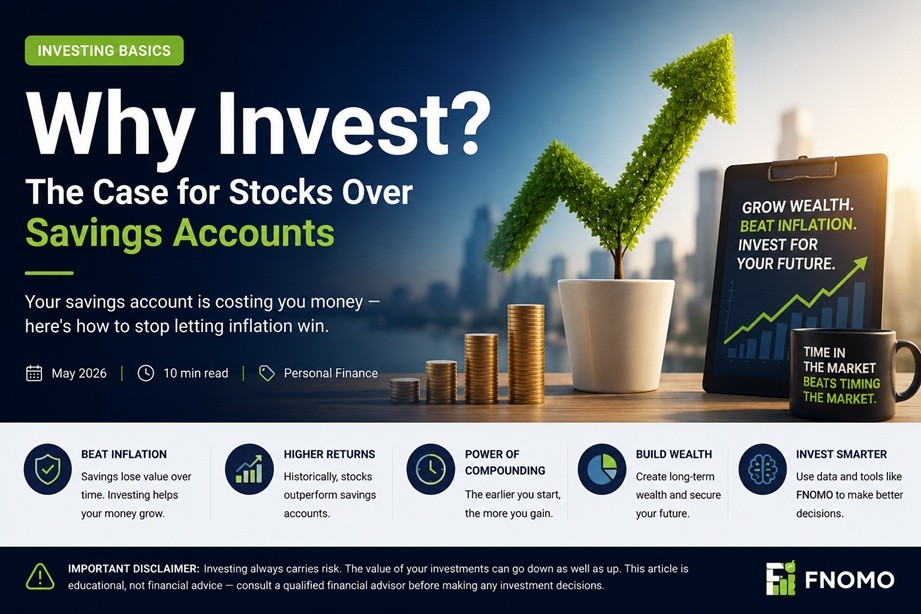
Why Invest? The Case for Stocks Over Savings Accounts
Your savings account is costing you money — here's how to stop letting inflation win.
You work hard for your money. You save carefully. And yet, at the end of each year, your savings account feels like it's standing still — or worse, quietly shrinking. If that sounds familiar, you're not imagining things. This is inflation at work, and it's one of the most overlooked financial forces affecting everyday people in the US and UK.
In this article, we'll break down why simply saving isn't enough, why the stock market has historically been a far more effective vehicle for growing wealth, and how tools like FNOMO can make the entire process smarter and more accessible for beginners.
The Silent Enemy: What Inflation Does to Your Savings
Imagine you put £10,000 or $10,000 into a savings account today. Your bank offers you a 2% annual interest rate, which sounds reasonable. But what if inflation is running at 3.5%?
In real terms, your money is losing purchasing power every year. That £10,000 today might only buy what £9,700 can buy next year — even though your bank balance says otherwise. After 10 years, the damage adds up significantly.
This isn't a trick or a financial illusion. It's the power of compound returns — and it's the single biggest reason why millions of people in the US and UK have started investing in the stock market.
Why the Stock Market Outperforms Savings Historically
The stock market isn't a get-rich-quick scheme. It's a long-term wealth-building engine with a well-documented track record. Here's what history tells us:
Savings Accounts vs. Stocks: A Side-by-Side Reality Check
"But Isn't the Stock Market Too Risky?"
This is the most common concern beginners have — and it's completely understandable. Markets do go up and down. But here's what most people miss: risk isn't just about volatility. Leaving all your money in a savings account is also a risk — the risk of inflation eating your purchasing power year after year.
The key is managing risk intelligently, not avoiding it entirely. And this is where approach matters more than prediction:
How Compounding Makes Stocks Even More Powerful
Albert Einstein allegedly called compound interest "the eighth wonder of the world." Whether or not he actually said it, the principle is undeniably powerful when applied to stock market returns.
Making Smarter Investment Decisions with FNOMO
Understanding why to invest is just the first step. The next — and often most intimidating — step is knowing where to start, what to look at, and how to filter through the noise of thousands of stocks, funds, and market signals.
This is exactly the problem that FNOMO is built to solve.
👋 How FNOMO Helps New Investors
Instead of spending hours reading financial reports or second-guessing your decisions, FNOMO brings clarity to the process:
- → Discover potential investments faster — filter stocks and funds based on performance, sector, risk level, and more.
- → Understand market data easily — visual dashboards replace confusing spreadsheets and jargon-heavy reports.
- → Build smarter portfolios with confidence — data-backed insights help you make decisions you can actually stand behind.
The biggest reason most people never start investing isn't lack of money — it's lack of clarity. Platforms like FNOMO exist precisely to close that gap, turning complex market data into actionable, beginner-friendly insights.
So — Savings or Stocks? The Honest Answer
The honest answer is: both have a role — but they serve very different purposes.
"The best time to start was yesterday. The second-best time is today."
Investing doesn't require wealth. It doesn't require a finance degree. It requires starting — and using the right tools to stay informed. FNOMO is built exactly for that journey.